Frieze Magazine
In the last few years, the American-born, Berlin-based artist
Dorothy Iannone has finally been getting a little more attention for the work
she made in the 1970s. Her video sculpture I Was Thinking of You (1975) – a
sarcophagus-size box, painted with a joyously erotic love-making scene and
including a built-in monitor screening a close-up video of the artist’s face
while masturbating – was plucked from relative obscurity and remade in three
different versions for presentations in The Wrong Gallery at Tate Modern in
2005 and in the 2006 Whitney Biennial. Her most recent solo exhibition of
paintings, works on paper and two other video sculptures from the same period,
as well as some recent screen prints, offered a rare opportunity to see more of
her work. These shows also confirm a wider and welcome readiness to understand
the ‘contemporary’ part of contemporary art as an indication of context and
currency of ideas, regardless of the age of the artist or of their work.
By all accounts something of a bohemian grande dame, Iannone has
a colourful and varied biography peppered with intense friendships with male
artists and writers, all of which are integral to an appreciation of her art,
particularly because her personal mythology, experiences, feelings and
relationships are often the subjects of her work. A literature graduate, she
illegally imported Henry Miller novels in the early 1960s into the USA and
successfully contested their censorship at trial. But her life-changing moment
came slightly later, in 1967, when she took a cruise from New York to Iceland
with her then husband. Waiting for them on a pier was artist Dieter Roth,
holding a fish. He and Iannone became lovers, Iannone left her husband, and she
and Roth remained companions until 1974, and lifelong friends until his death
in 1998. During their time together they were immersed in the vibrant
Dusseldorf Fluxus scene, although she would later inscribe on a piece: ‘I am
she who is not Fluxus.’ While they were together Iannone’s practice matured
from her take on Abstract Expressionism to a multimedia, ornamental, figurative
and folkish style shamelessly celebrating what she describes as her ‘ecstatic
unity’ with her lover. In 1976, after receiving a DAAD scholarship to come to
Berlin, Iannone moved to the city where she still resides and holds court
today.
Decades on, ‘Follow Me’, a satisfying if modest exhibition – in
terms of its scale and the number of works on display – picked up the story. In
recent interviews, Iannone has seemed philosophical about the ups and downs of
her career (which never actually stopped), citing commercial disinterest in her
work, censorship of her shows and her increasing involvement in making artist’s
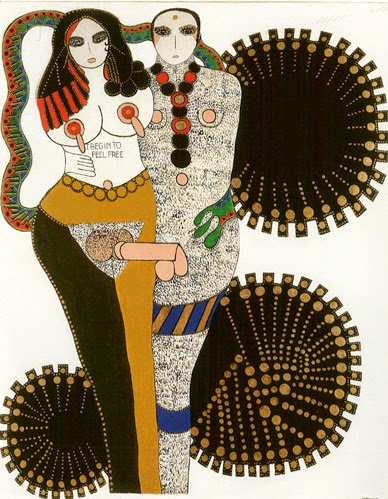
books. On display were three sex paintings from the pivotal chapter in her
career: I Begin to Feel Free (1970), I Love to Beat You (1969–70) and Think You
There Was … (1972). These are as radiant and provocative as the day they were
made. One of the first striking things about the paintings is the artist’s
graphic depiction of male and female genitals. For Iannone they are best
pictured swollen with the anticipation of pleasure, not so much awkward
appendages as rudders, compasses and festive brooches. Her labia, for instance,
usually look as visually prominent as any scrotum or erectile tissue a male
might have to offer. Though apparently heterosexual to the core, her take is a
Utopian one in which the perspective and power is shifted to the female –
always a triumphant, self-defining being, not a vessel or a victim.
Interestingly, Iannone maintained a distance (albeit a
respectful one) from emergent Feminist theory and its protagonists. To take an
extreme comparison, one could think of the gulf between Iannone’s position and,
say, the rhetorical battle cry of Valerie Solanas’ S.C.U.M. Manifesto (1967).
The work that lent this exhibition its title, Follow Me (1977), is nonetheless
a kind of celebration of a lost matriarchal golden age. It takes the form of a
three-panel black and white paravent with a video monitor built into it. The
video shows the artist’s face as she sings one of her texts, which is also
copied out on the panels. The front is ornamented with her self-portrait as a
naked, opulent siren or goddess beside her lover. Next to this piece stood the
altar-like painted video box The Heroic Performance of Pastor Erik Bock …
(1980). For this work, the artist fixed her camera on her then lover, a sexy
preacher man, who awkwardly delivers an hour-long sermon on Christian love and
community, while the painting on the box looks more like a free-love nudist
colony. But the real spirit at work is Iannone’s, and her own infectious blend
of playful seduction, iconoclasm and particular brand of sexual liberation –
something that, in many quarters, is still much needed.
Dominic Eichler



++2002+by+Kiki+Smith.jpg)


